Healthcare is constantly evolving. Clinical guidance changes, referral pathways are refined and digital services continue to mature. For healthcare technology providers, responding to that change is not simply about delivering something new. It is about making sure every update is safe, reliable and ready for clinical use.
At DXS, that means recognising that the best route to go-live is not always the fastest. For clinically sensitive pathways, an iterative approach to development and testing helps ensure changes are thoroughly validated before they reach frontline clinicians.
A recent project to modernise a suspected-cancer referral pathway illustrates why that matters.
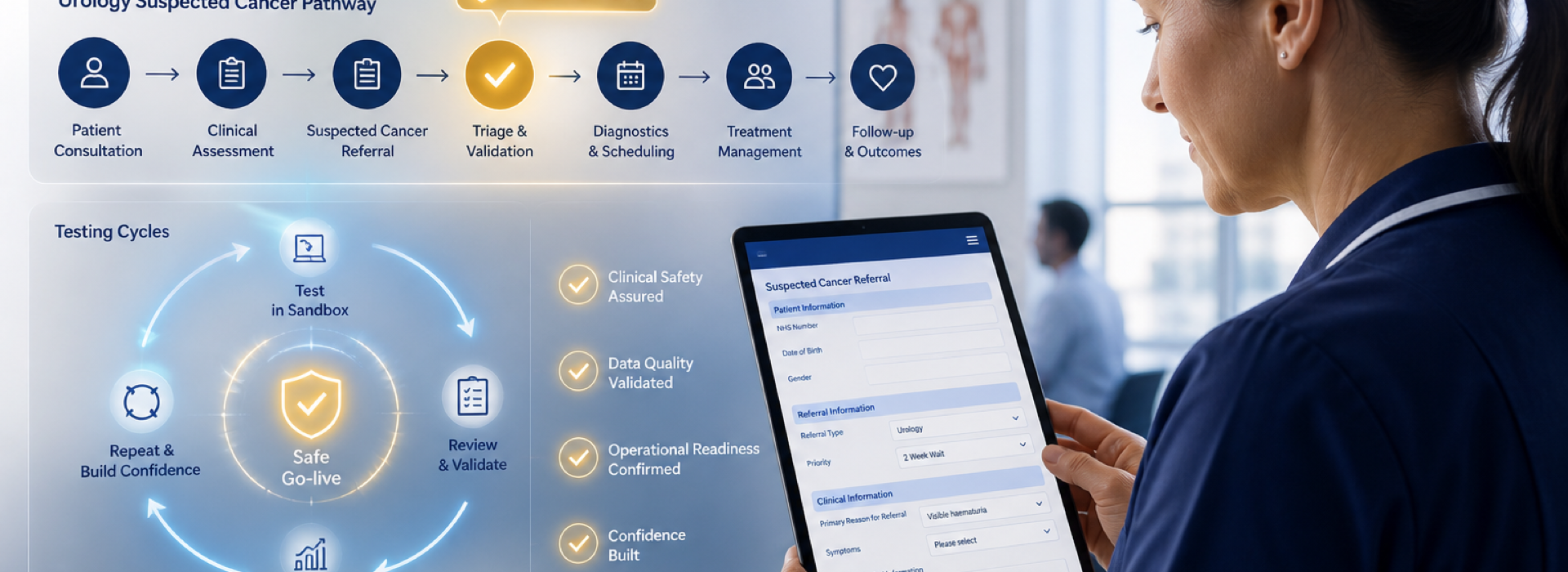
The South and West Herts Urology Suspected Cancer Referral project focused on replacing an existing live referral form with a significantly enhanced SMART-enabled version.
Rather than introducing incremental changes directly into the live form, the replacement was developed and refined within a dedicated test environment. This allowed substantial improvements to be made while preserving the stability of the existing referral pathway until the new version had been fully validated.
The updated form incorporated enhanced SMART features designed to create a more intuitive referral experience while supporting accurate and complete referrals.
Suspected-cancer referrals are among the most clinically significant pathways within primary care. Changes to these forms therefore need to be approached with particular care.
As enhancements were introduced, the form went through multiple rounds of refinement and testing. Each cycle helped confirm that conditional logic, validation, navigation and SMART features behaved as intended before the project moved forward.
This iterative process also meant feedback could be incorporated throughout development, allowing improvements to be made before deployment rather than after release.
While additional testing can extend development timelines, it also provides greater confidence that the final solution will perform consistently when it is used in a live clinical setting.
Modern SMART capabilities can significantly improve the referral experience by helping clinicians complete forms more efficiently and consistently.
The revised form introduced improvements designed to support usability while maintaining the integrity of the referral pathway. Repeated testing and validation helped reduce the risk of unexpected behaviour at go-live and provided greater confidence that the replacement form was ready for production use.
The result was a safer route to replacing a complex referral form, with testing and validation built into the development process rather than treated as a final-stage check. At the same time, the enhanced SMART features were able to support clinicians more effectively while reducing the likelihood of defects emerging after deployment.
Digital transformation in healthcare is rarely about delivering change as quickly as possible. It is about delivering change responsibly.
For clinically important pathways, investing time in iterative development and thorough testing helps ensure that new functionality supports clinicians without introducing unnecessary risk.
Projects such as the South and West Herts Urology Suspected Cancer Referral demonstrate how DXS approaches complex content updates with clinical safety and quality at the forefront.
By refining, testing and validating before go-live, we help ensure that enhancements deliver value from day one while maintaining confidence in the systems healthcare professionals rely on every day.
Interested in how DXS can help your organisation develop and validate clinically critical referral pathways with greater confidence? Get in touch – hello@dxs-systems.co.uk
