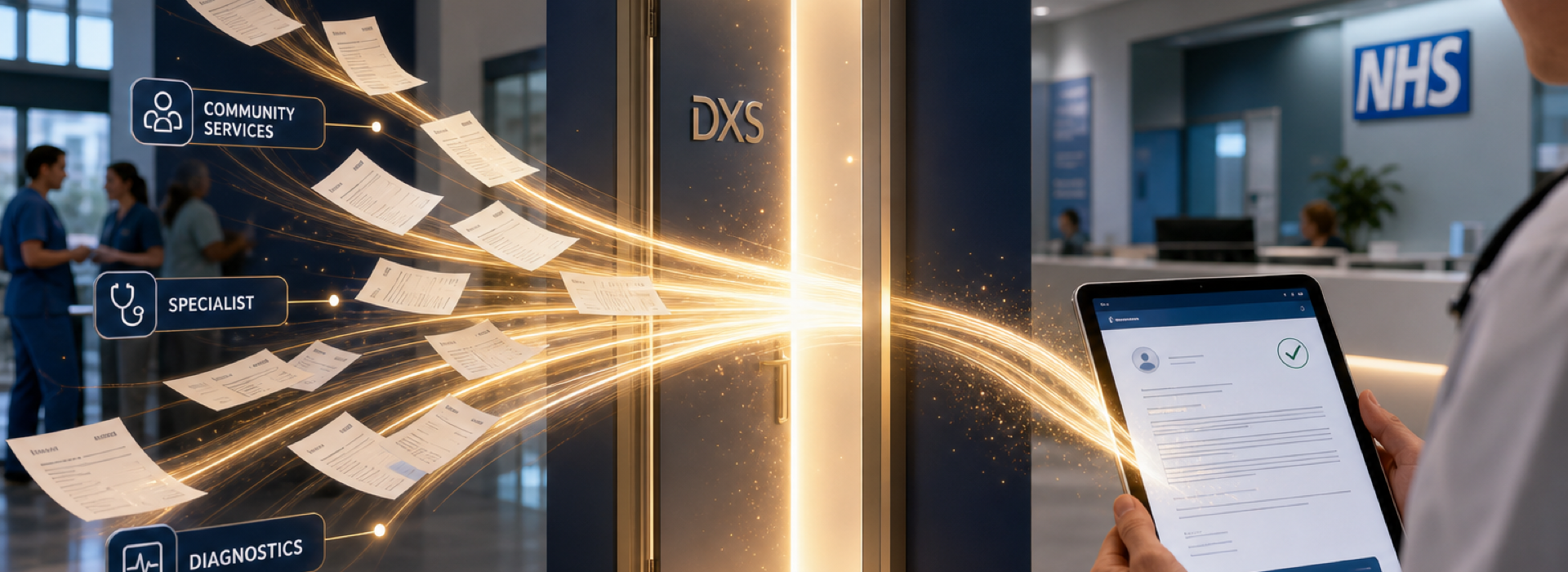
Healthcare services are becoming increasingly interconnected. Community providers, specialist services and integrated care systems all depend on referral pathways that span multiple organisations, each with their own local requirements.
For clinicians, however, the goal remains simple: refer the patient to the right service as quickly and accurately as possible.
Too often, that means navigating multiple referral forms that collect similar information while differing only in service-specific requirements.
Rather than simplifying the process, complexity is pushed back onto the referrer.
Referral consolidation offers a different approach.
Instead of maintaining separate forms for every service, multiple pathways can be brought together into a single intelligent referral that guides clinicians through the appropriate route while adapting dynamically to each patient’s needs.
Recent projects delivered by the DXS Content Team demonstrate how this approach is helping organisations simplify referral management without sacrificing local flexibility.
A recent dermatology project spanning four organisations across the former Frimley system brought their referral requirements together into a single digital referral.
Rather than maintaining multiple forms with significant overlap, the new solution provides one entry point while intelligently directing clinicians through the appropriate pathway based on their selections.
Conditional navigation presents only the questions relevant to the chosen service, reducing unnecessary data entry, shortening completion time and allowing clinicians to focus on the information that genuinely matters for the patient’s referral.
The project also introduced an authorised tester workflow – giving named stakeholders early, controlled access to try the consolidated referral for themselves – so it could be fully validated before deployment, ensuring confidence in the final solution.
A similar approach was taken for Medway Community Healthcare, where multiple community service referrals were consolidated into a single SMART referral.
Rather than expecting clinicians to decide which referral form they need before they begin, the system guides them through the correct pathway as information is entered.
The referral combines several intelligent features, including:
The result is a referral experience that is quicker to complete, easier to navigate and better aligned with the way clinicians actually work.
Referral consolidation involves far more than combining several forms into one.
Behind the scenes, intelligent SMART functionality allows complex referral pathways to remain simple from the clinician’s perspective.
Conditional navigation adapts questions dynamically based on responses, while auto-population reuses information already held within the clinical record, reducing unnecessary manual entry and improving consistency.
The result is an experience that feels straightforward for users, even when supporting numerous services with different referral criteria.
One of the greatest challenges in referral consolidation is finding the right balance between consistency and local requirements.
Standardisation reduces variation, simplifies maintenance and creates a familiar experience for clinicians working across multiple organisations.
At the same time, individual providers often have legitimate local clinical and operational requirements that cannot simply be removed.
Using configurable SMART functionality, organisations can establish a common referral framework while preserving service-specific questions and workflows wherever they are needed.
This provides a single entry point for clinicians without compromising local flexibility or governance.
Whether bringing together services across multiple organisations or simplifying referrals within a single provider, intelligent referral consolidation helps reduce administrative burden while improving the overall referral experience.
Projects such as the Frimley dermatology referral and Medway Community Healthcare’s consolidated SMART referral demonstrate how thoughtful digital design can make increasingly complex service structures significantly easier to navigate.
The result is a referral process that supports clinicians, reduces unnecessary effort and remains flexible enough to meet local needs.
As healthcare systems continue to evolve, consolidation will become increasingly important – not simply as a way to reduce the number of referral forms, but as a way to make referral pathways more intuitive, scalable and sustainable. The same principles are being carried forward into the development of DXS Next-Gen.
Interested in learning how DXS can simplify complex referral pathways through intelligent SMART referrals? Get in touch – hello@dxs-systems.co.uk
